Todd was testing out his 3D printed panorama tripod mount for his camera and came up with this awesome shot of our machine shop:
Sector67’s Rosetta@Home Effort Update

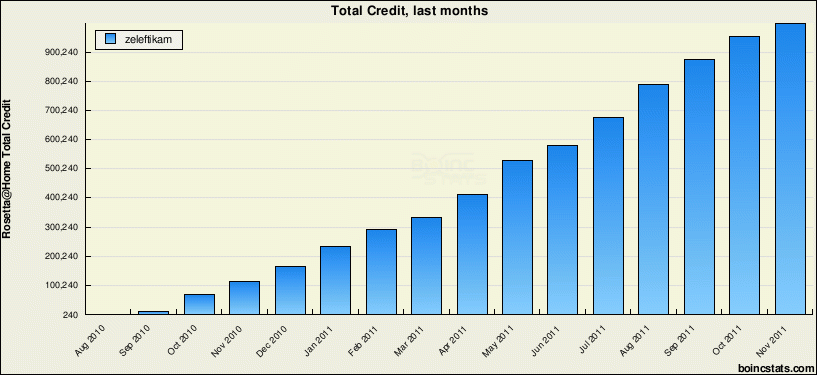
A milestone was reached on Tuesday, November 15, as Sector67 member Dougal processed enough Rosetta@Home work units to achieve one million earned credits in the BOINC distributed computing system. The goal was to reach 1M by 1/1/12. It took just over a year of constant processing by numerous CPUs (including some cloud computing resources) to reach this somewhat arbitrary benchmark. On Tuesday, a small pizza party was held to commemorate this achievement. Sector67 has been host to a number of participating computers over the year, which has been keeping the loft nice and toasty. Computers in the back lab also participate when they are powered on but idle. This is the strange looking screen saver you might have noticed before. This was also how we unexpectedly encountered the limit of our computer lab’s circuit breaker.
Rosetta@Home is a distributed computing project for protein structure prediction, run by the Baker Laboratory at the University of Washington. The project aims to predict protein–protein docking and design new proteins with the help of about sixty thousand active volunteered computers processing at 62 teraFLOPS on average as of October 18, 2011. Rosetta@Home consistently ranks among the foremost docking predictors, and is one of the best tertiary protein structure predictors available.
Rosetta uses idle computer processing resources from volunteers’ computers to perform calculations on individual workunits. Completed results are sent to a central project server where they are validated and assimilated into project databases. The project is cross-platform, and runs on a wide variety of hardware configurations.
In addition to basic research in predicting human protein structure, docking, and design, Rosetta@Home is also used in immediate disease-related research. Understanding protein structures will facilitate the creation of smart drugs to combat ailments such as Alzheimer’s disease, Anthrax, Herpes, HIV, and Malaria. Participants who predict protein structures are acknowledged in scientific publications regarding their results.
Users can join “teams,” which tally the total credits earned by all the team members. I am presently a member of the UW-Madison team, but if there is interest from other members in participating in the project, we would love to create a Sector67 team and crunch with you. You can get started by downloading BOINC and attaching Rosetta@home as your project.
Contact Dougal at dougal [at] uwalumni.com if you’re interested in organizing a team.
I was sick of getting flat bicycle tires, so on reading a few seat belt bike tire liner tricks online, I was ready to give it a shot. Having a few donor seat belts (that also found their way onto the 7cees bus) laying around certainly helped!
The trick is pretty straightforward, get a seat belt:

Chop to appropriate length:

Deflate and debead half of the tire to insert the seat belt:

Reinsert the tube:

Find someone with small hands to help reseat the tire and get things ready to go:

Test!

(Just kidding, I don’t think this would survive the bandsaw for long. . . although no flats to report in several months!)
She climbs into the fuselage and takes her seat in front of the brightly lit control panel. A tune starts to play as she slides the first lever into position. She presses a button and a rhythm glides in behind the tune. Is this the start of a new science fiction film? No, it’s what happens when makers, a supportive company and a non-profit work together. The result is “Rock-it!”, an Arduino powered interactive music creation exhibit. The project started when Dennis Adams heard the Madison Children’s Museum was moving to a new location. Wondering how he might get involved, Dennis and fellow makers Mark Siegenthaler and Matt Logan approached their employer, Sony Creative Software, about funding a music creation exhibit. With Sony’s support, the makers pitched the idea to the Children’s Museum. The proposal was accepted in early 2010 and the work began. The artists at the Children’s Museum decided they would build the enclosure, while the makers would create the consoles and supporting electronics. The museum decided to build a retro rocket ship built from the front of an old, repurposed airplane. This gave the makers a framework for designing and building their consoles.
The key goal of the project was to make the exhibit fun and interactive. The makers wanted to be sure it made good music regardless of the levers and buttons used. They also wanted to make sure it was interesting regardless of how many kids were using it, so unused panels automatically change settings over the course of the song. The melody levers proved to be a design challenge. Their positioning and calibration was critical. The electronics also proved challenging with noise problems creating further complications. The end design uses an Arduino Mega to communicate with three control panels for button and position inputs and LED outputs, and it generates MIDI messages to the music synthesizer. It also holds the three songs used in the exhibit. A SM Pro V-Machine is the synthesizer which turns the MIDI into rich, layered stereo audio. It is a full x86 computer that runs the same VST synthesizers and filters you’d use on a PC. This configuration allowed Mark to compose the music on his full synth keyboard while Matt shoehorned the music into the Arduino along with the rest of the programming. On the surface, children see control panels with LED lit levers to control the melody, buttons controlling rhythm and an effects pad overhead for additional options.
The project took over a year of on and off effort, with the exhibit finally being installed this past September in the Possible-opolis section of the museum. The museum says “Rock-it!” is a hit. If you want to see it in action but can’t visit in person, check out the video:
Thanks to some special makers in Madison, children who visit the museum learn anyone can make music.
To learn more about this and other interesting maker projects, join us at one of our Sector67 open meetings or visit us on the web at http://www.sector67.org.
The giant double decker bus has left the Sector67 parking lot! We’re excited and definitely feeling a little emptier in more than a few ways 😉 Thankfully they’ve safely made it to their first destination and are one step on the way across the country.
Feel free to connect with them on their website, if you’re along their path I’d encourage you to meet up with them when they’re nearby, it’s hard to miss!
Thanks for the shoutout guys and good luck!
Sector67 was invited out to UW Platteville as part of a contingent of Capital Entrepreneur Members to meet with students and inspire them to follow their creative ideas.
We had a lot of fun at the event, and are looking forward to seeing the UW Platteville students taking the next steps towards starting their own businesses!
The Wausau Daily Herald mentions Sector67 as an inspiration for the starting Wausau Collaboration Center.
“Bourke’s inspiration came from a makerspace in Madison, called Sector67. The brainchild of engineer Chris Meyer, Sector67 offers Madison-area residents and students a place to come together and collaborate on anything from new products to businesses.
“It was one of those places where everyone was friendly and there were a lot of cool, interesting things in there,” Tom Bourke said of his visit this summer to Sector67.
As soon as he saw Sector67, he said he believed he could launch something similar in Wausau.”
What happens when you combine a 3,000 lb computer controlled milling machine and a holiday requiring hand-eye coordination? CNC pumpkin carving! Taking it to a new level this year, we attempted both full carving and just removing the skin and part of the pumpkin flesh to get interesting light patterns. It’s very difficult to get consistent light through the pumpkin given the external and internal curvature, 3D scanning and compensation was definitely discussed but without a running 4th axis it’s difficult to accomplish anyways.
Without further ado:
Thanks to Ed for figuring out the cool patterns, and manning the mill for 4 hours waiting for frankenstein to finish up with the 1/8″ end mill. We subsequently switched to a much larger endmill and simple rough mill procedure rather than a full milling complement. Eventually ending up with a 5″ long 5.1mm drill bit to accomplish the full cut for the toothy smile. CNC carving is definitely faster than by hand 🙂
Video:
Many at the monthly meeting, Larry is giving a brief talk about his automated chicken coop door (now of Hackaday fame):

Madison’s Steam Century used Sector67 to create the murder mystery props for Geek.Kon:

Sometimes Makerbot repair requires two hands and a couple Coronas to get anywhere. . .

At Sector67 we take safety very seriously. In the event of pencil lead breakage, all bystanders need to be wearing proper Personal Protective Equipment (PPE):

The kitchen sees its first use for a real meal (Thanks to Restore for good prices on all the pieces and Isthmus Engineering for contributing our stove!):

More Makerbot repair, this time a first generation Makerbot has finally let the ghost out of the power supply after over a year of solid operation (Less Coronas, more hands, also a valid strategy):

The bus is underway towards a new paint job. Some body work and primer is getting it closer to rocking a new style:

UW’s FH King student gardens use Sector67 to construct a solar dehydrator to extend their vegetable distribution season:

What’s that being worked on, it’s hard to tell from this angle. . .

Could it be an old school dual scope night vision system?

Can’t imagine flying an Apache with these things on, but this modern monocular sure looks pretty in comparison:

The helmet mount helps, yes, you can see in pure blackness as I’m sure the neighbors were wondering wth we were doing running around behind the building . . .

Lastly, Leon is putting the finishing touches on an entirely homebuilt ultrasonic soldering system. Not only is it a fluxless process, but it’s able to solder directly onto glass (look closely at the lightbulb)

If you’ve ever wondered what it takes to drive a high power ultrasonic transducer, it’s not much:

Lastly, the first RepRap Prusa clone rolls off the Makerbot assembly line. All dressed up in shiny white plastic:

Sector67 contributed to the Global Wisconsin Idea Program this summer, helping to educate 19 Chinese and US students about robotics and electronics. We taught a soldering class:
http://stationaery.com/gwip/field-trip-to-sector-67/
PDF: Global Wisconsin Idea Program – Soldering
and an Arduino class:
http://stationaery.com/gwip/lesson-on-social-robotics-arduino/
PDF: Global Wisconsin Idea Program – Arduino
and had a lot of fun using the localized Chinese version of Windows – thankfully the icons are the same 🙂